
“Alignment is almost a project in itself… a core competency for the company. If you want to create a living strategy, you have to keep reviewing it, communicating it, integrating new data points, and talking to the organisation in a way that helps people act on it.”
Henry Ruiz, CEO, Lifestyle Communities, Australia
Is your organisation struggling with…

An inability to sprint and pivot in an environment of rapid change?

Silos and poor collaboration leading to wasted effort, duplication and rework?

A lack of trust in each other, the strategy and the ability to execute?

A sense that you’re not progressing because you’re always fighting fires?
The issue might not be your strategy, leadership or capability. It may be that your organisation isn’t aligned.
Your people don’t share a genuine understanding of where your organisation is going and why… an understanding that shows up in how they make decisions and do work.
If this sounds like you, there are two pieces of good news. Your’e far from alone and there are actions you can take.
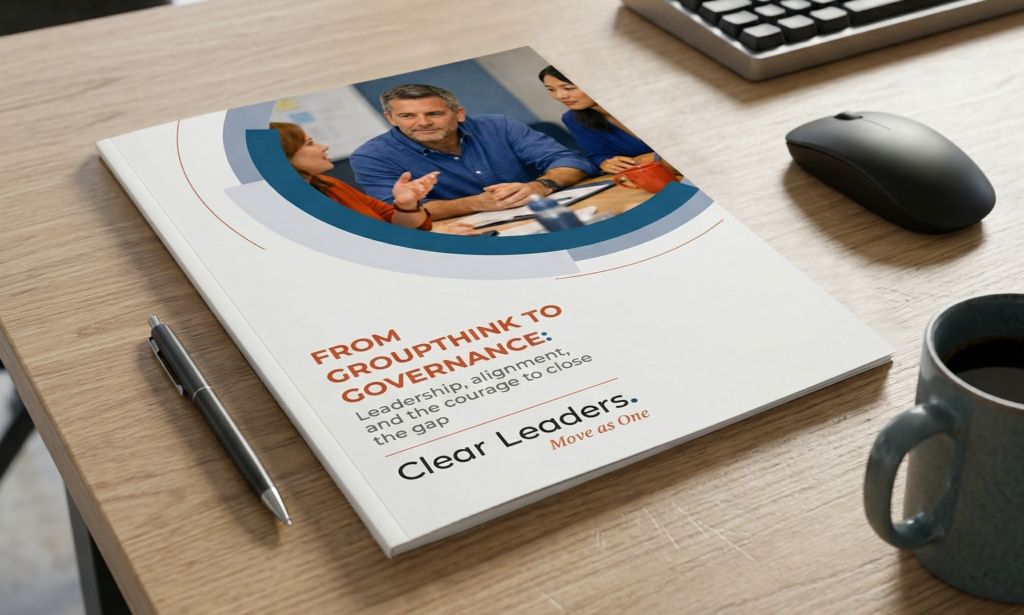
Start by reading From groupthink to governance… the groundbreaking new research paper from Clear Leaders.
Strategic alignment matters, but…

An overwhelming number of leaders agree. Strategic alignment matters more than ever. It holds organisations together at a time of accelerating change and uncertainty.
Despite this, enabling alignment has proven elusive. This results in a misalignment tax: a steady drain on capacity, speed, time and relationships that most organisations have learned to absorb rather than address.
91%1
of leaders said strategic alignment was fundamental to organisational goals.
56%2
of business leaders feel their executive team works effectively together.
13%1
of leaders believed their organisations were highly aligned.
149%3
rise in Glassdoor reviews using the word ‘misalignment’ to describe senior leadership in just one year.
1: Trevor, Jonathan ‘What Leaders Get Wrong About Strategic Alignment’, HBR 15 January 2026
2: Global Leadership Monitor, Russell Reynolds Associates, 2,700 business leaders, 40 countries, H1 2024
3: Glassdoor Economic Research, ‘Glassdoor’s Worklife Trends 2026’, 12 November 2025
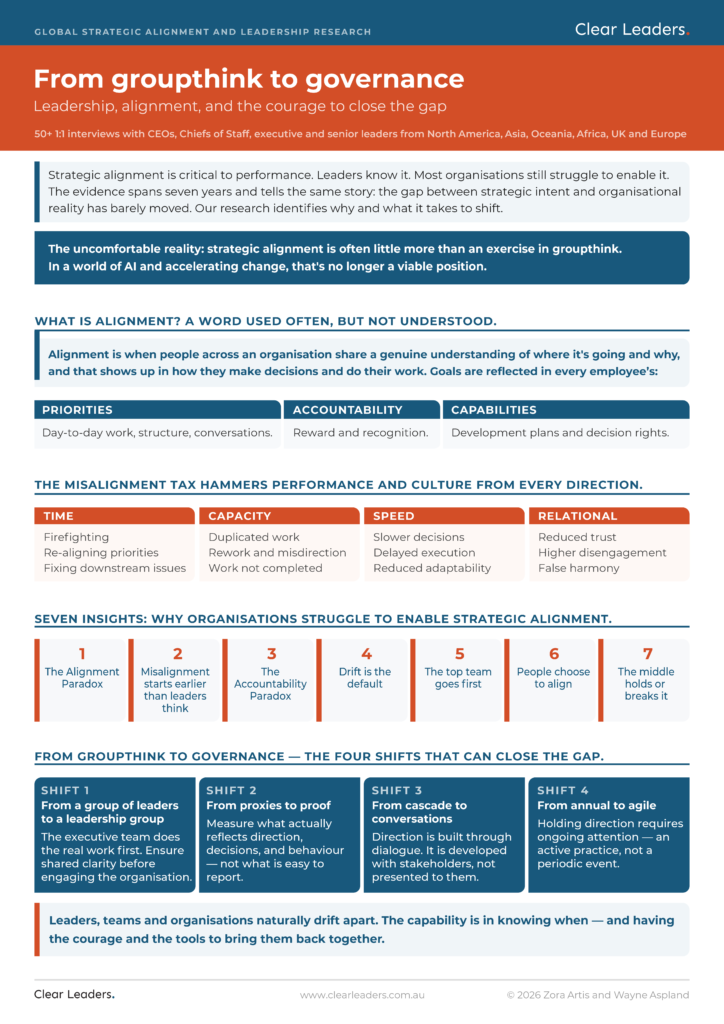
From groupthink to governance.
A new global study into strategic alignment and leadership.
Why is alignment so challenged? What does closing the gap require?
To find out, we interviewed 55 senior leaders from five continents. CEOs, Chiefs of Staff and leaders in strategy, HR, operations and communication.
Our third strategic alignment study surfaces an uncomfortable truth. In most organisations, alignment is assumed rather than enabled. It’s an exercise in groupthink rather than a serious leadership discipline.
We need to rethink the way we enable alignment: from groupthink to governance. That requires four fundamental shifts:
- From a group of leaders to a leadership group
- From proxies to proof.
- From cascade to conversations.
- From annual to agile.
The full paper sets out what these shifts require in practice.
Clear Leaders. Move as One.
Most organisations know how to launch a strategy. Where they struggle is sustaining strategic alignment as conditions change, priorities compete and pressure increases.
This is where we work. Typically, with executive teams and their direct reports, when:
- The strategy is agreed upon, but interpreted differently across the leadership group
- Teams make progress, but it doesn’t add up at the enterprise level
- The effort is high, but progress is slower than it should be
- Work is duplicated or reworked, rather than building momentum
We work with leaders and teams at every level to make gaps visible early, build shared understanding through structured, ongoing dialogue, and strengthen the capability to sustain alignment under pressure.
The work changes how leaders and teams collaborate—their conversations, decisions, trade-offs, and habits that either maintain direction or cause it to drift.
The goal is leaders and teams who don’t require a program to do this. They understand, practise, and embody it.
About the authors.
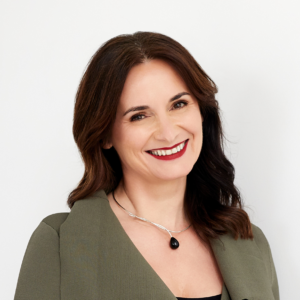
Zora Artis, GAICD, IABC Fellow, SCMP, ACC, FAMI, CPM
Zora helps leaders do the hard work of alignment when the stakes are high and the path is not obvious. As CEO of Artis Advisory and co-founder of The Alignment People and Clear Leaders, she coaches, advises, and facilitates C-suite and senior teams through change and complexity – turning competing priorities into clear decisions, stronger cohesion, and coordinated action.

Wayne Aspland, MAICD, FCSCE
Wayne is a leadership, strategy and change communication professional. He helps organisations and teams realise their potential in today’s new world of work. A world where the opportunities created by AI are balanced against the strain of accelerating change and uncertainty. This is achieved with a focus on enabling AI capability, strategic alignment and communication and chage capacity.